
Blown-In Attic Insulation in Leander, TX
Blown-in attic insulation is a loose-fill material – cellulose or fiberglass – machine-blown across your attic floor to fill gaps, cover joists, and bring your home up to the R-38 to R-60 depth that Leander’s climate demands. Most jobs in a standard Leander home run between $1,400 and $3,200, and the work is usually completed in a single day. If your upstairs rooms feel noticeably warmer than the rest of the house by June, or your utility bills have been climbing without an obvious cause, blown-in insulation is almost always part of the answer.
At Topside Attic Insulation Leander, we’ve been doing this work under The Haven Standard since 2016 – which means you get a written price before anyone touches your attic, and a documented photo record when we leave. Wes Okafor built this company around one rule: air sealing comes before insulation, always, no exceptions. That rule matters more in Central Texas than people realize, and we’ll explain exactly why below. If you’d like to start with a price, call us at (737) 252-7159 – a live person answers, not a voicemail system.
This page covers blown-in insulation specifically. For a broader look at all attic insulation options available in this area, our Attic Insulation in Leander page walks through the full picture.
When You Need Blown-In Attic Insulation
- Your upstairs is 5-10 degrees warmer than your downstairs in summer. Leander sits in a climate zone where attic temperatures regularly hit 140-150°F on July afternoons. Without adequate insulation depth – typically R-49 or higher for this zone – that heat transfers directly into your living space. We see this constantly in the Crystal Falls and Travisso neighborhoods, where two-story homes built between 2010 and 2018 often left the attic underinsulated.
- Your energy bills have increased without a clear explanation. If your Oncor or Pedernales Electric bills have crept up year over year and your HVAC unit hasn’t changed, the attic floor is a common culprit. A blower-door test – a pressurization measurement that produces a single CFM50 number showing how much conditioned air your home is losing – often confirms it.
- You can see the tops of your attic joists. If you can see the wood framing when you look across your attic floor, your insulation depth is almost certainly below R-19. That’s less than half of what Leander’s climate requires. Blown-in material is the most practical way to bring that depth up quickly across an irregular floor layout.
- Your home was built before 2000. Older homes in the Leander area – particularly those in the original subdivisions west of US-183 – were built to code minimums that are now significantly below current energy standards. Many have settled fiberglass batts that have lost R-value over time and need to be either supplemented or replaced.
- You’ve had recent HVAC work but still aren’t comfortable. A new air handler won’t fix a thermal envelope problem. If your HVAC contractor has already ruled out equipment issues, the next logical step is an attic inspection. We regularly find that the unit is sized correctly but the attic is losing conditioned air before it reaches the living space.
- You’re preparing to sell or refinance. Home energy assessments are increasingly common in the Leander market, and an attic with sub-standard insulation depth will show up in a report. Bringing the attic to current R-value standards before the inspection is a straightforward way to avoid a negotiated credit at closing.
Our Blown-In Attic Insulation Process
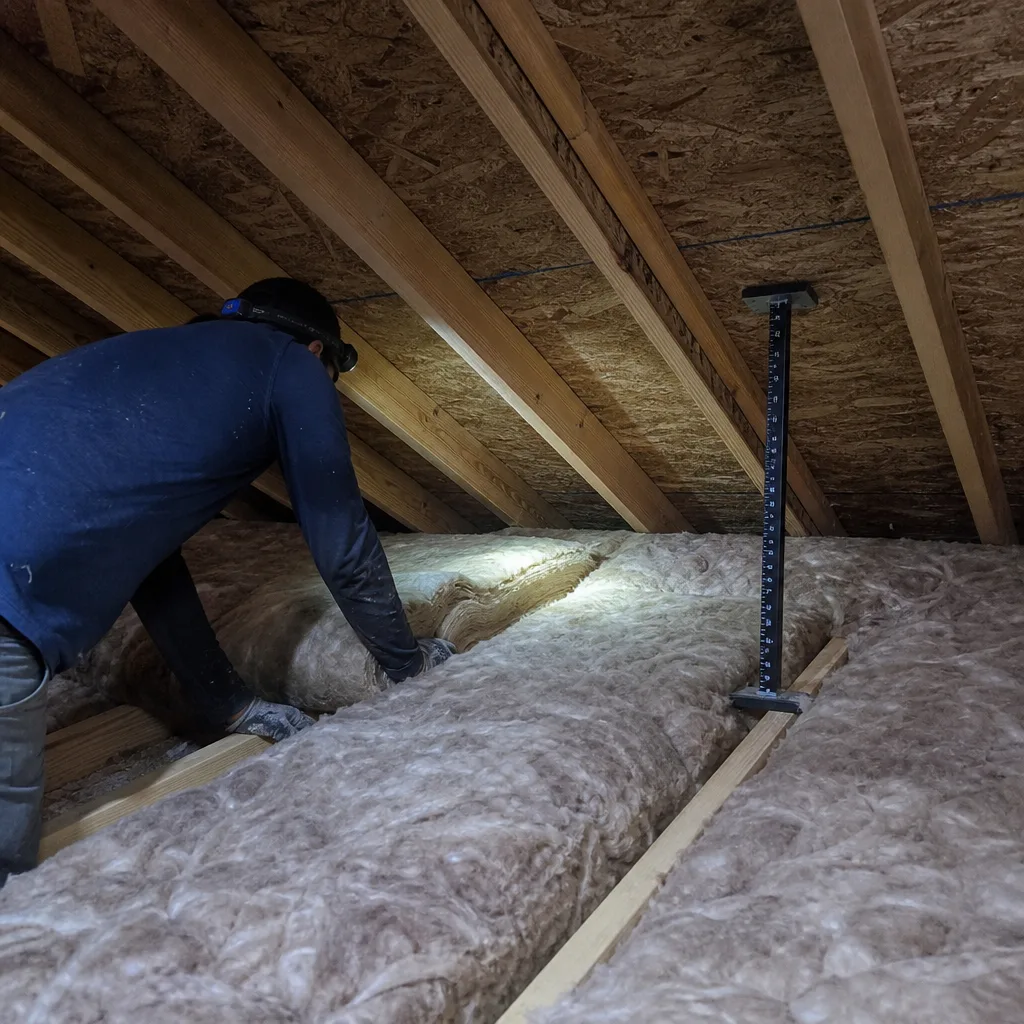
The sequence matters as much as the material. Here’s what actually happens on a Topside job, from the first measurement to the final photo.
- Written scope and price before any work begins. Under Haven Standard Clause 1, you receive a flat written price and a written scope of work before we schedule a crew. No estimates that “might change once we get in there.” If we quote a job, that’s the number. Wes Okafor reviews every scope personally for jobs in Leander before it goes out.
- Pre-job blower-door test (on applicable jobs). Before we touch anything, we pressurize the home and record the baseline CFM50 reading. This number tells us – and you – exactly how much conditioned air the building envelope was losing before any work started. It’s the “before” number we’ll compare against when the job is done.
- Air sealing of the attic floor – completed before any insulation goes in. This is the step most contractors skip or offer as an add-on. We don’t. Every top plate gap, recessed light fixture, plumbing penetration, and HVAC boot is sealed with fire-rated foam or caulk before the insulation machine starts. In Leander homes with open-cell spray foam HVAC closets and can lights over living areas, this step alone can cut the CFM50 reading by 30-40%. Skipping it and blowing insulation on top of unsealed gaps is like putting a thick blanket over a screen door – the heat still gets through.
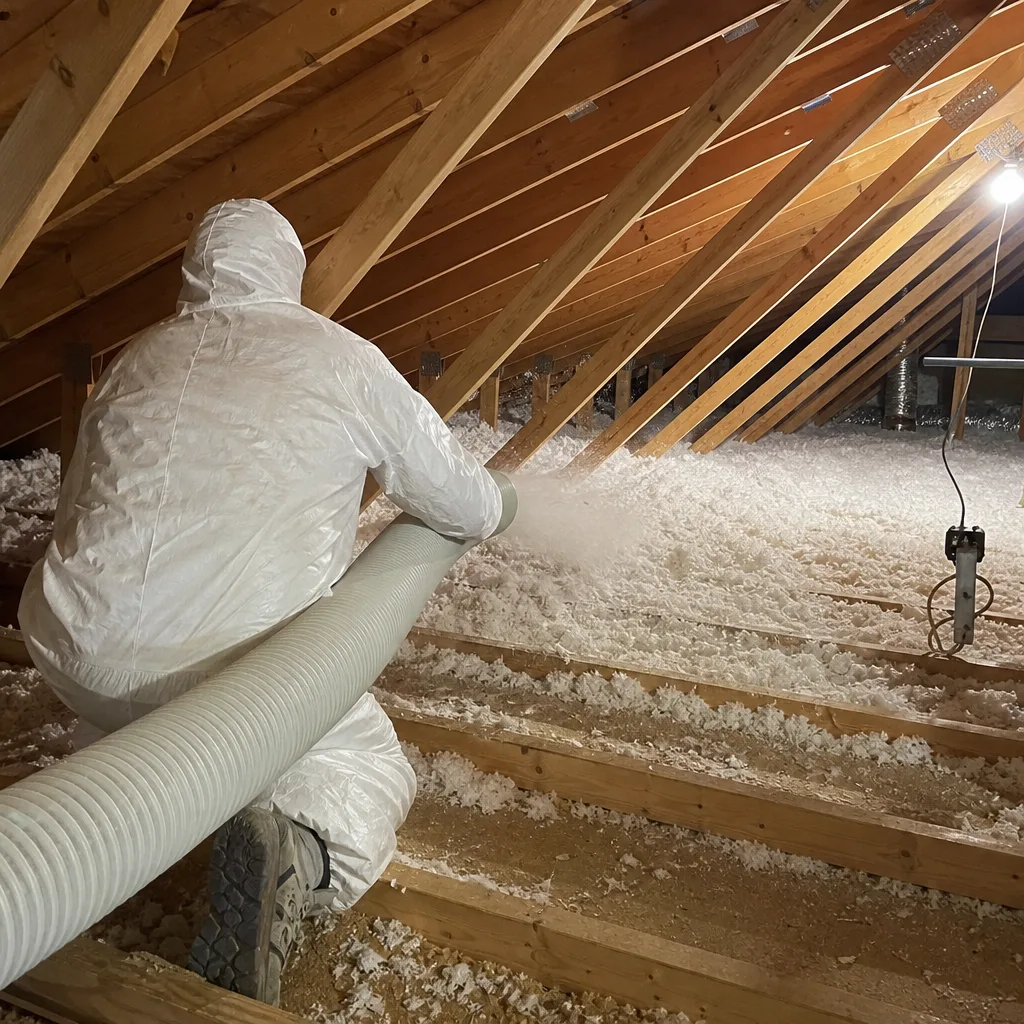
- Blown-in installation to the specified R-value. We use GreenFiber cellulose or Owens Corning fiberglass blown-in material depending on the job requirements and moisture conditions in your specific attic. Depth gauges are placed across the attic floor before the blower starts so you can verify the final depth matches the written scope. In most Leander homes, we’re targeting R-49 to R-60, which means 15 to 20 inches of settled depth depending on the material used.
- Post-job blower-door test and documentation. Once the attic is sealed and insulated, we run the blower door again. You get both numbers – the before and the after – in writing. On a well-sealed job in a typical 2,000-square-foot Leander home, we routinely see the CFM50 drop from the 3,500-5,000 range down to 1,800-2,600. That’s a documented, measurable result, not a feeling.
- Documented photo record delivered before we leave. Every job closes with a photo record of the attic floor before work, during air sealing, and after insulation. The photos are time-stamped and tied to the job scope. You don’t have to request them – they’re part of every Topside job under the Haven Standard.
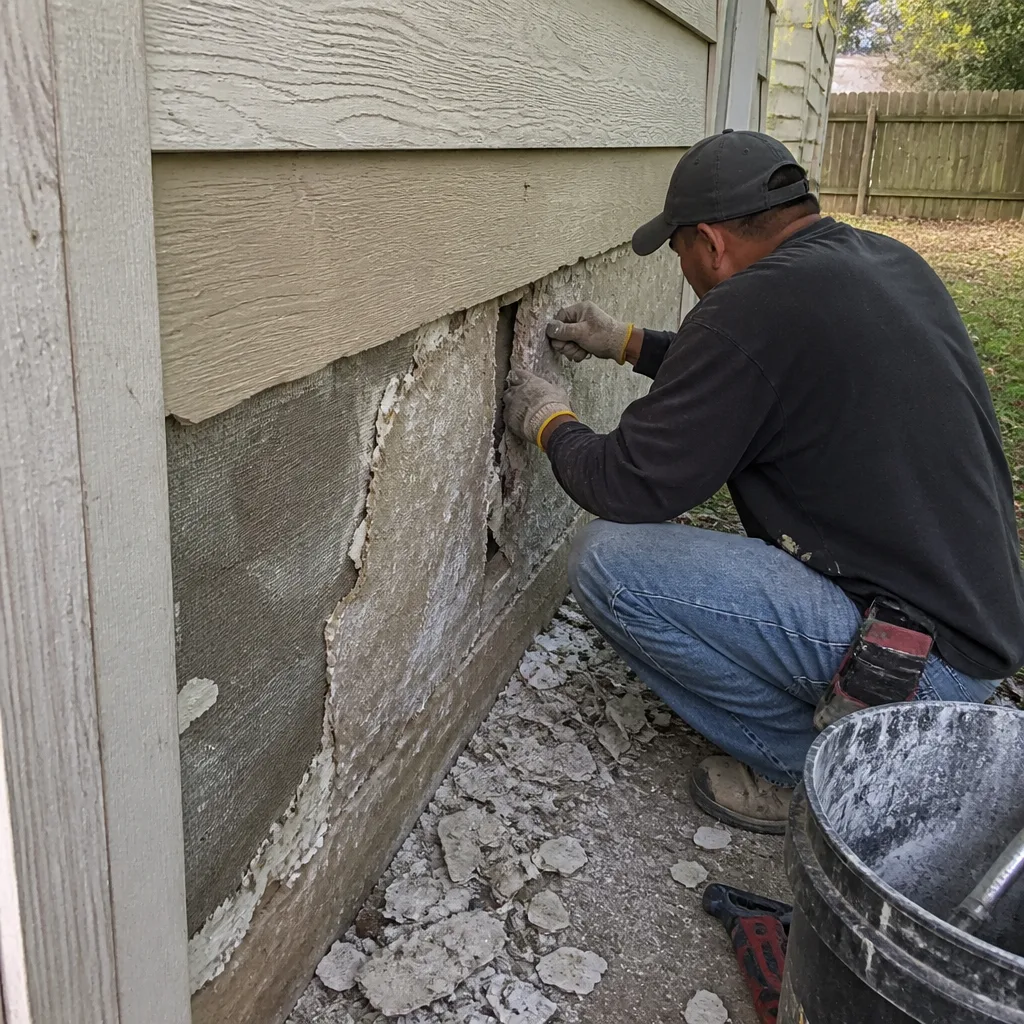 Before
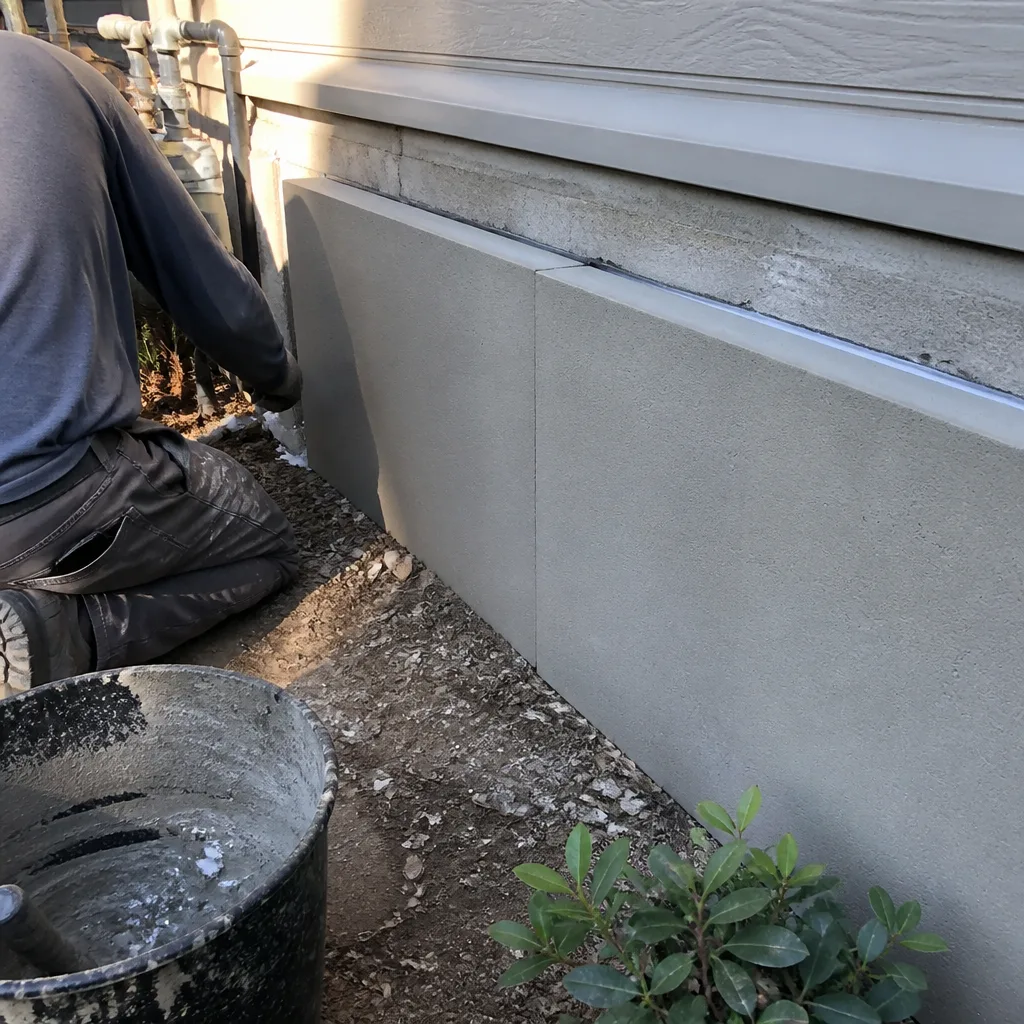 After
AfterBlown-In Attic Insulation Pricing in Leander
Most our Attic Insulation services jobs in Leander run between $1,400 and $3,200 for a standard single-family home. The range is wide because several variables genuinely move the number, and we’d rather give you an honest range than a low figure that changes once we’re in your attic. Here’s what drives the cost:
| Factor | Typical Impact on Price |
|---|---|
| Square footage of attic floor (1,200-2,800 sq ft is common in Leander) | Primary driver – larger attic = more material and labor |
| Starting R-value (existing insulation depth) | Lower starting point = more material needed = higher cost |
| Target R-value (R-38, R-49, or R-60) | Each step up adds material cost; R-60 is roughly 25% more material than R-38 |
| Air sealing scope (number of can lights, penetrations, top plates) | Homes with many recessed lights or older framing can add $300-$600 to the sealing phase |
| Attic access difficulty (low pitch, HVAC equipment in the way) | Can add $150-$400 depending on conditions |
| Material choice (cellulose vs. fiberglass blown-in) | Generally within 10-15% of each other; we’ll explain the tradeoffs for your specific attic |
A few specifics that are common in Leander: homes in the Bryson and Block House Creek areas frequently have attic access points above garage ceilings with limited clearance, which adds labor time. Homes in Travisso with tile roofs and lower pitch profiles sometimes require additional setup for the blower hose run. We account for all of this in the written scope before any work starts – not after.
The pre-job blower-door test and the post-job blower-door test are included on applicable jobs. The documented photo record is included on every job. These are not line items you’ll find as add-ons on your invoice.
If you’ve received a written estimate from another contractor, bring it to us. We offer a free second opinion on any written estimate – we’ll read it with you and tell you what it includes, what it doesn’t, and how it compares to what we’d scope for the same job. Call (737) 252-7159 to set that up.
Why the Air-First Rule Matters in Leander Specifically
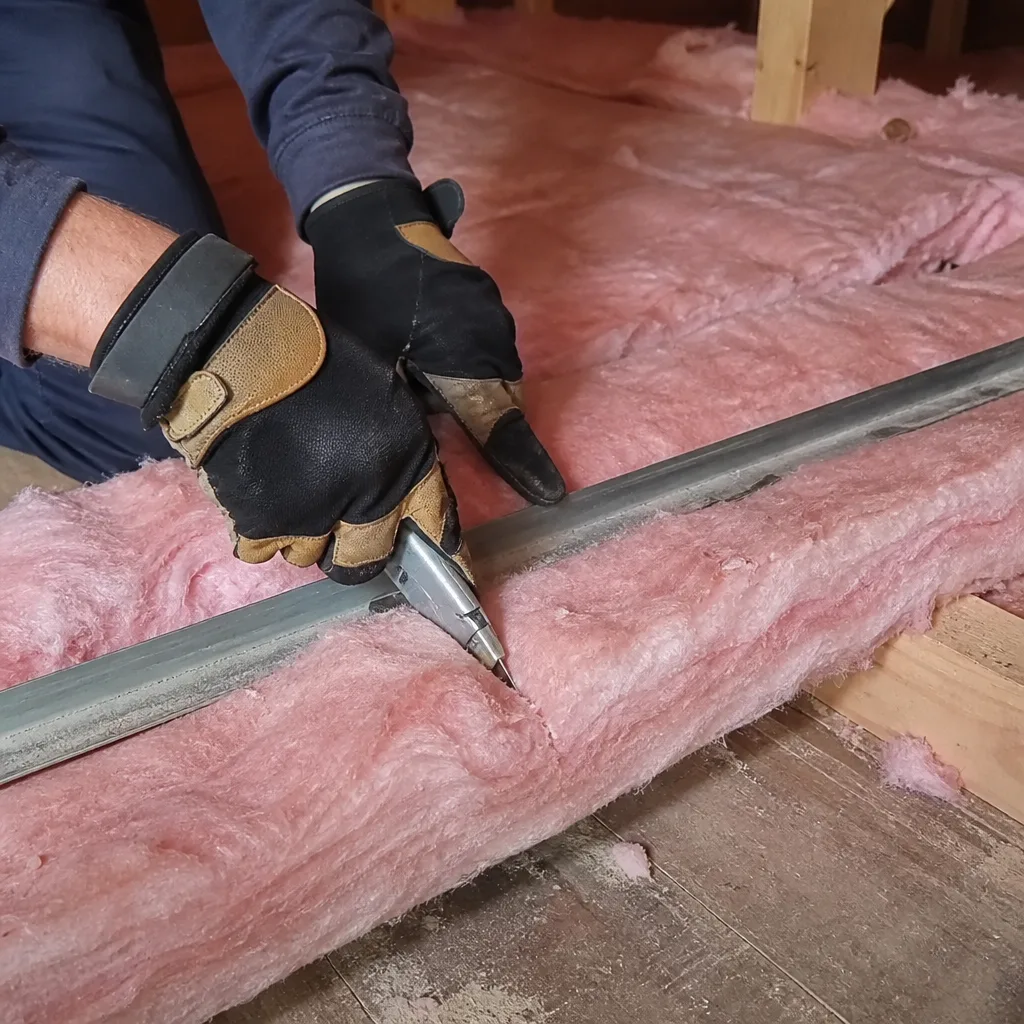
Central Texas has a long cooling season – typically May through October – and a short but real heating season in December and January. That means your home’s building envelope is fighting heat gain for most of the year, not heat loss. The physics of this matter: in a hot climate, the biggest enemy isn’t low R-value alone, it’s stack effect and air movement carrying humidity and heat into the conditioned space through attic floor gaps.
Blown-in insulation slows conductive heat transfer. But if your attic floor has unsealed top plates and recessed lights, hot attic air is actively infiltrating the house – moving through gaps, not just transferring through material. Insulation doesn’t stop moving air. Air sealing does. This is why Envelope Insulation Co. never starts the blower without completing the sealing phase first, and it’s why we publish both blower-door numbers so you can see the air-sealing result independently of the insulation depth.
We’ve found that Leander homes built in the 2005-2015 window – a high-volume construction period in this area – commonly have dozens of unsealed recessed can lights in ceilings below the attic. Each one is a direct hole between the conditioned space and the 140-degree attic above. Sealing those before blowing insulation is not optional on a Topside job.
Our full home page covers the complete building-envelope service line if you want context on how attic insulation fits alongside crawl space work, radiant barriers, and energy audits.
Material Options: What We Use and Why
We source from Owens Corning, GreenFiber, Johns Manville, Knauf, and others – no proprietary product lock-in. For blown-in attic applications in Leander, the two most common choices are:
- GreenFiber cellulose blown-in: Made from recycled paper fiber treated with borate for fire and pest resistance. Settles slightly over time (we account for this in the target depth), handles irregular spaces well, and has a slightly higher R-value per inch than standard fiberglass blown-in. Works well in most Leander attics. We’ve used GreenFiber in jobs from Crystal Falls to Savannah Hills.
- Owens Corning fiberglass blown-in: Doesn’t settle, performs well in attics with higher moisture exposure (relevant in lower-lying Leander lots near Brushy Creek), and is inorganic so there’s no food source for mold or insects. Slightly lower R-per-inch, which means more depth is needed to hit the same R-value target.
We’ll tell you which material makes more sense for your specific attic conditions during the scoping visit, and the written price will reflect exactly what you’re getting.
FAQs – Blown-In Attic Insulation in Leander
How much does blown-in attic insulation cost in Leander, TX?
Most blown-in attic insulation jobs in Leander run between $1,400 and $3,200 for a single-family home, depending on attic square footage, the starting R-value, the target R-value, the scope of Attic Baffles & Ventilation Prep, and air sealing required. Homes with many recessed can lights or difficult attic access tend to land in the upper part of that range. Under Haven Standard Clause 1, you receive a written flat price before any work starts – the number on the scope is the number on the invoice. Call (737) 252-7159 to get a written price for your specific attic; there’s no charge for the estimate.
Do you have to remove old insulation before blowing in new material?
Not always. If your existing insulation is dry, free of rodent contamination, and structurally intact, blown-in material can be added directly on top of it to bring the depth up to the target R-value. If we find moisture damage, pest activity, or insulation that has been significantly compressed or displaced, removal is the right call before anything new goes in. We document the condition of your existing insulation with photos during the scoping visit so you can see exactly what we found and why we’re recommending what we are. Topside also offers insulation removal and replacement as a separate service if that’s the appropriate path.
What R-value do I need in my Leander attic?
Leander falls in IECC Climate Zone 2, and the current energy code calls for a minimum of R-38 in existing homes, with R-49 to R-60 recommended for homes targeting meaningful utility savings. In practice, most homes we insulate in Leander are brought to R-49 as a baseline, with some homeowners choosing R-60 if their attic access and budget allow. We’ll measure your current depth, calculate what’s needed to reach the target, and put that target R-value in the written scope before any work starts.
How long does blown-in attic insulation last?
Properly installed blown-in cellulose or Attic Batt Insulation in a dry, well-sealed Leander attic lasts 20 to 30 years without significant performance loss. The main threats to longevity are moisture intrusion (from a roof leak or inadequate ventilation), rodent activity, and significant settling in cases where the attic wasn’t adequately sealed before installation. The documented photo record we provide on every job gives you a clear baseline – if something changes in your attic years from now, you have a record of what it looked like when the work was done. The 365-Day Done Right Promise covers the installation itself: if it’s not right within the first year, we make it right.
Key Takeaways
- Blown-in insulation in Leander typically costs $1,400-$3,200; the written price is fixed before any work starts.
- Air sealing of top plates, can lights, and penetrations is completed before the blower runs – always.
- Before-and-after blower-door numbers are documented on applicable jobs so you can verify the air-sealing result.
- GreenFiber cellulose and Owens Corning fiberglass are both available; material choice is based on your attic’s specific conditions.
- Leander’s climate zone targets R-49 to R-60 for meaningful energy performance.
- The documented photo record and 365-Day Done Right Promise are included on every completed job.
Get a Written Price for Your Leander Attic
If you’re ready to know what blown-in insulation will actually cost for your home – not a ballpark, a written number – call Topside Attic Insulation Leander at (737) 252-7159. A live person answers every call. We’ll schedule a scoping visit, measure your attic, document what we find, and give you a flat written price before anything else happens. If you’ve already received a competing estimate, bring it. The second opinion is free, and we’ll go through it with you line by line.
For the full picture on attic insulation options in this area, see our Attic Insulation in Leander page.
Written by Wes Okafor, Owner at Topside Attic Insulation Leander, serving Leander.